Wednesday, February 27, 2007 8:00AM to 1:00PM
*Note: To Ross and Briercheck Productions "can you capture the deed?"
Monday, January 22, 2007

Whittemore 422 / Somewhere in the 8th House
Previous Pontiac Expeditions (PLEASE FORWARD ANY PICTURES FOR INSERTION)
South Edith: 279. 283. 287.
Going: 281. 294.
Osmun: 355. 359.
South Edith: 279. 283. 287.
Going: 281. 294.
Osmun: 355. 359.
Sunday, January 21, 2007
DIGITAL Promise.....Just Continue to...DO IT!
Published 13 November 2006
Securing U.S. Public Funds for Educational Technology Research and Development:
Additonal: Learning to Learn / Luskin Interview
http://www.imsglobal.org/articles/18Sep2006Luskin1.cfm
Digital Promise Project
http://www.digitalpromise.org
An Interview with Larry Grossman of the Digital Promise Project
Lawrence K. (Larry) Grossman is co-chair of the Digital Promise Project with former FCC Chairman Newton N. Minow of "TV is a vast wasteland" fame. Mr. Grossman is former president of NBC News and PBS. Before that he founded an advertising agency to serve media and not-for-profit public service clients and was vice president of advertising at NBC. After leaving NBC News, Mr. Grossman held the Frank Stanton First Amendment Chair at the Kennedy School of Government, and was senior fellow and visiting scholar at Columbia University. He serves on the boards of various educational, science, public broadcasting, and health organizations and is author of The Electronic Republic: Reshaping Democracy in the Information Age.
IMS Global Learning Consortium recently talked with Mr. Grossman about Digital Promise and the need for federal legislation to support research and development of advanced information technologies to serve the public interest, particularly in education, skills training, and lifelong learning and to help bring museums and libraries and the nation's public institutions into the digital age.
IMS Global: Perhaps a good place to start is to define for us what is the Digital Promise Project? What exactly do you hope to achieve?
LG: Digital Promise began in 1999, before the nation had any public policy or serious discussion about how to exploit the great potential of the new information technologies to serve the public interest, especially in education, skills training, and lifelong learning. A group of major foundations, including Carnegie, Century, Knight, MacArthur and Open Society, were concerned that in the approaching digital age, the rapid advance of new information technologies was revolutionizing the commercial segments of our society - in communications, business, banking, finance, entertainment, and manufacturing, to name a few. But the nation's nonprofit and civic institutions - our schools, libraries, museums, universities, and other public institutions that serve the crucial centers of our society were being left behind in the emerging digital age. The foundations asked Mr. Minow and me to direct a project that would develop recommendations for what should be done. We agreed to take on the job on a pro bono basis. After extensive research and interviews throughout the nation, we concluded that the U.S. had an overwhelming need to launch a new, federally financed R&D trust fund that would do for education, lifelong learning, and skills training in the digital age what the National Science Foundation does for science, NIH for health, and DARPA for the military. We called our proposed trust fund the Digital Opportunity Investment Trust, or DO IT, and urged that it grow eventually into a billion dollar a year fund to transform the nation's learning and training through intelligent use of advanced information technologies.
IMS Global: Is the Digital Divide in this country growing wider?
LG: The term Digital Divide usually refers to the disparity of access to computers and the Internet by the affluent and by inner city, rural and economically deprived segments of our population. That disparity continues, although in most parts of the nation it is diminishing. Increasingly schools are encouraging and subsidizing the use of computers by students. The great majority of today's students, even in poor communities are "digital natives," at least when it comes to the hardware. According to the most recent Department of Education report, 97% of high school students today have access to computers. Most have some experience using the Internet. The real deficit we see today is not in the hardware as much as it is in the development of educational and training software and content. The real opportunity and need is to transform education, lifelong learning and training for the digital age by the application of the remarkable new advanced information technologies that are being developed every day.
The federal government funds substantial R&D that translates into advancements in key U.S. industries, and those investments pay off handsomely in improved productivity. Unfortunately there is no such R&D model for education. U.S. taxpayers invest nearly $1 trillion per year on K-12, higher education, and skills training, yet we invest relatively little to explore the application of technology for learning. And what little is spent goes to the Defense Department, which is making extraordinary advances in training troops through information technologies. But what they're learning is not available to the general population. Most formal teaching and learning still use 19th century methods: reading texts, listening to lectures, blackboard exercises, and the like. Firms and industries with higher IT intensity have higher levels of productivity growth. In education today, low IT intensity yields low, in fact diminishing productivity. A recent Commerce Department study of 55 industries found that the education and training services industry has the lowest IT-intensity of the industries studied, even though education is arguably one of the most knowledge intensive industries of all.
As the Federation of American Scientist's Kay Howell has written recently in e-learn, "When we talk about technology for learning, we're talking about much more than using email to communicate with students, Google for doing homework research, and Powerpoint slides to support distance learning. We're talking about sophisticated information technologies tightly integrated into daily learning activities. We know that such software tools are possible because of the way information technology has been used in other service sector industries: powerful simulations and visualization tools used in computer games and movies; sophisticated help systems to provide accurate answers to questions; websites to undertake continuous evaluations of the individuals who use them, often tailoring offerings to interests and preferences revealed by the user. These technologies can be adapted to learning and will make it practical to adopt approaches to education that learning scientists have been advocating for years. New communication tools could enable learners to collaborate in complex projects and ask for help from teachers and experts from around the world. Learning systems could adapt to differences in student interests, backgrounds, learning styles and aptitudes. They could provide continuous measures of competence, integral to the learning process that can help teachers work more effectively with individuals and leave a record of competence that is compelling to students and to employers. And new tools could allow continuous evaluation and improvement of the learning systems themselves."
IMS Global: The R&D that is being conducted in other countries - is that being subsidized by their governments?
LG: Substantially. Other nations, ranging from Great Britain, to India, Singapore, and Italy are setting aside substantial amounts of money to bring their students up to speed. And we, alarmingly, and ironically, are falling way behind in comparison with just about all developed nations in how our students are progressing in math, science, reading and other basics.
And keep in mind that when we talk about the need for DO IT to invest in technology, we're not talking about buying computers and hardware as much as we are focusing on content and software. We have great precedents in American history for farsighted, transformative legislation that improved and expanded public education and higher education. One of the very first actions of Congress, the Northwest Ordinance of 1787, required every new state to reserve public land to pay for public education, which started public education in the young nation, and indeed, in the world. In 1862, in the midst of the Civil War, Congress passed and Lincoln signed the Land Grant Colleges Act, called by historian Alan Nevins the most farsighted legislation in the nation's history. That act also required public land to be set aside in every state to help finance public higher education that would increase our nation's competitiveness with Europe by developing more productive agriculture and advanced manufacturing. The result is today's remarkable network of 105 outstanding public research universities serving every state. That act did provide no funds for buildings; it was assumed that the states would pay for that. The money from the federal legislation was to pay for teacher salaries, textbooks, and content. And in the 20th century, Congress passed the GI Bill of 1944, which opened higher education to millions of veterans and helped bring unprecedented post-war prosperity to the nation. In that spirit, we believe America needs once again to act and to provide a transformative education initiative for the 21st century.
IMS Global: The Digital Promise Project is seeking to establish the Digital Opportunity Investment Trust (DO IT), the proceeds from which would be used to provide this type of research. How would the trust be funded? And how much money is needed to adequately support the type of R&D that is needed?
LG: There is no more publicly owned frontier land to help pay for this initiative, but today's equivalent is the publicly owned telecommunications spectrum, the radio and television frequencies that Congress has mandated be auctioned off for commercial uses such as cell telephones and digital transmissions. We said that eventually the interest earned on just 20 percent of the revenues received from those auctions of this publicly owned resource would amount to over a billion dollars a year. That trust fund money should be spent, at the direction of Congress, on critically needed R&D to help bring our schools and universities, our libraries and museums, our essential nonprofit civic and scientific organizations into the digital age. The trust fund would be overseen by a blue ribbon board of directors, recommended by those in the disciplines it serves, nominated by the President and confirmed by both houses of Congress. DO IT would be modeled on the National Science Foundation. We need that kind of decision-making authority so that the best ideas in education and learning can be funded, and partnerships can be established with the private sector, with states and local school districts, as well as with libraries and museums and similar public institutions. DO IT would start in a modest way, and build up its funding just as NSF has done since its launching in 1950.
IMS Global: Who would own this trust fund?
LG: The federal treasury would hold the auction revenues, which would be treated as an asset of the federal government. The interest from those revenues would be spent by DO IT under the direction of its independent board, with annual oversight by Congress.
IMS Global: What kind of support are you getting for this proposed legislation?
LG: We have strong bipartisan sponsorship of the bills in both the Senate and the House (The Digital Opportunity Investment Trust Act, S 1023 and HR 2512). Of course, given what Congress is up against these days with the budget deficit and the war, our goal now is to get this proposal started and its operations tested in a modest way. Given the pace of technological change, and the essential need to transform the quality and modernize our systems of education, we want to see a modest fund established as soon as possible, the board of directors appointed, and the priorities set by the DO IT board.
IMS Global: The IMS Global Learning Consortium recently came out and publicly endorsed this initiative. What kind of response are you getting from the other nonprofit and for-profit organizations?
LG: Just about every major national organization representing our nation's museums, libraries, universities, schools and teachers have strongly supported the DO IT effort. The National Council of Mayors has given its endorsement. The former chair of the National Governors Association has supported it. High tech companies, in particular, like Google, E-Bay and Hewlett-Packard are on board. And we have on the DO IT leadership council prominent people in many fields ranging from former Senator Warren Rudman to Internet pioneer and Presidential Medal of Freedom honoree Vinton Cerf to former National Science Board Chair Eamon Kelly.
IMS Global: How can individuals, organizations, and companies get involved?
LG: We'd welcome them to join the DO IT coalition. Endorse the Digital Promise initiative and the current legislation. Let others know of their support. Write, phone, and contact their legislative leaders urging them to sponsor and vote for the DO IT legislation. We'd certainly welcome any grants of financial support for the Digital Promise Project through donations to our coalition partner, the Federation of American Scientists. We are conducting public forums throughout the nation, producing our website (www.digitalpromise.org) and publications, and supporting our two staff members - our extraordinarily hard working and talented executive director and her deputy in Washington, DC, Anne G. Murphy and Rayne Guilford. For specific information, draft letters of endorsement, lists of your legislators, and further information go to the DO IT website: www.digitalpromise.org.
IMS Global: Private enterprise has done a pretty good job of developing and applying technology. Don't companies have a role to play here in developing technology?
LG: Certainly, they do. The job of the Digital Trust is to encourage the private sector to develop technology for public interest and public service uses by providing funds to stimulate R&D. Content is expensive to create and the marketplace does not encourage developing new and advanced software for not-for-profit uses such as in education, training, museums and libraries. Rights issues and standards for that development need to be worked out. Digital Promise has been influential in getting modest Congressional appropriations for the Federation of American Scientists, our leading coalition member in Washington, to develop prototype educational games and a learning R&D roadmap to demonstrate what can be done. You will find examples of these prototypes on our website, www.digitalpromise.org. The beauty of the new technologies is that once the software is developed, the costs of distribution through the Internet, digital public television stations, CDs and DVDs, are minimal. They can actually be made available to the entire world.
IMS Global: If America doesn't make this investment in developing information technologies for the sake of learning, don't we run the risk of falling behind other nations?
LG: We have already fallen behind other nations. Recent reports from the Council on Competitiveness of the corporate world, and the National Academies of Science document that fact. The influential U.S. Commission on National Security in the 21st Century warned: "The inadequacies of our systems of research and education pose a greater threat to U.S. national security over the next quarter century than any potential conventional war that we might imagine. American national leadership must understand these deficiencies as threats to national security. If we do not invest heavily and wisely in rebuilding these two core strengths, America will be incapable of maintaining its global position long into the 21st century."
IMS Global: What you're talking about here seems to go to the heart of DOE's commission findings on the need for assessment for accountability and accessibility.
LG: Testing, or assessment, has become central to new educational initiatives, in order to demonstrate accountability, productivity and responsible use of funds. With the new information technologies, we not only can assess how far students have come through standardized tests, but far better, can assess each person's individual strengths and weaknesses. Teachers and parents, and the students themselves, then can learn exactly what needs to be done and how it can best be achieved for each student. The best education, after all, is interactive and individually focused.
IMS Global: Considering your extensive background working in television, what do you believe we've learned from working in multimedia and its application to learning?
LG: The Digital Promise Project actually got its start by focusing on television, especially public television. Back in the 1990's I served on the board of Connecticut Public Television and chaired its strategic planning committee. Congress mandated that all television stations, public and commercial, had to convert to digital from analog distribution, a much more efficient use of the publicly owned radio spectrum. Digital TV allows many more channels per frequency; makes interactivity possible, and improves the quality of sound and picture. It became clear that Connecticut public television had to redefine its role in this new digital environment. In a digital world it has the opportunity to bring into the home, school and workplace the state's libraries and museums, which contain the DNA of our civilization; the services of its schools and universities, its public health and civic centers. Our project aroused the interest of the major foundations which then broadened the inquiry to explore the ways in which the new information technologies could serve the public interest. The result of our research was a book published in 2001 called A Digital Gift to the Nation, which laid out our recommendations, which eventually were translated into federal legislation in the House and Senate.
IMS Global: Are you frustrated that this initiative is not getting as much visibility as it should? Or that it is taking so long to gain momentum?
LG: The slow pace of progress can certainly be frustrating. But look at the precedents for our effort. The farsighted Land Grant Colleges Act was vetoed twice before it was signed by President Lincoln signed. The GI Bill was passed out of committee by just one vote. And a Senator had to be carried from his sick bed to cast that vote. In 1950, landmark legislation establishing the National Science Foundation was ready for passage when North Korea invaded South Korea. All new programs were put on hold, given the need to build up our armed forces and prepare for war. Eventually Congress realized the critical importance of improving and expanding our nation's investment in science. And so NSF received a small appropriation to start, and now has evolved as a major national force for innovation in science with a budget of several billion dollars a year.
We are optimistic that Digital Promise will have similar long-term success, and will be voted by Congress if not in this session, then in the next. As Brooklyn Dodger fans used to chant, (WE AT WHITTEMORE 422, MUST NOT AND WILL NOT) "Wait `til next year."
Securing U.S. Public Funds for Educational Technology Research and Development:
Additonal: Learning to Learn / Luskin Interview
http://www.imsglobal.org/articles/18Sep2006Luskin1.cfm
Digital Promise Project
http://www.digitalpromise.org
An Interview with Larry Grossman of the Digital Promise Project
Lawrence K. (Larry) Grossman is co-chair of the Digital Promise Project with former FCC Chairman Newton N. Minow of "TV is a vast wasteland" fame. Mr. Grossman is former president of NBC News and PBS. Before that he founded an advertising agency to serve media and not-for-profit public service clients and was vice president of advertising at NBC. After leaving NBC News, Mr. Grossman held the Frank Stanton First Amendment Chair at the Kennedy School of Government, and was senior fellow and visiting scholar at Columbia University. He serves on the boards of various educational, science, public broadcasting, and health organizations and is author of The Electronic Republic: Reshaping Democracy in the Information Age.
IMS Global Learning Consortium recently talked with Mr. Grossman about Digital Promise and the need for federal legislation to support research and development of advanced information technologies to serve the public interest, particularly in education, skills training, and lifelong learning and to help bring museums and libraries and the nation's public institutions into the digital age.
IMS Global: Perhaps a good place to start is to define for us what is the Digital Promise Project? What exactly do you hope to achieve?
LG: Digital Promise began in 1999, before the nation had any public policy or serious discussion about how to exploit the great potential of the new information technologies to serve the public interest, especially in education, skills training, and lifelong learning. A group of major foundations, including Carnegie, Century, Knight, MacArthur and Open Society, were concerned that in the approaching digital age, the rapid advance of new information technologies was revolutionizing the commercial segments of our society - in communications, business, banking, finance, entertainment, and manufacturing, to name a few. But the nation's nonprofit and civic institutions - our schools, libraries, museums, universities, and other public institutions that serve the crucial centers of our society were being left behind in the emerging digital age. The foundations asked Mr. Minow and me to direct a project that would develop recommendations for what should be done. We agreed to take on the job on a pro bono basis. After extensive research and interviews throughout the nation, we concluded that the U.S. had an overwhelming need to launch a new, federally financed R&D trust fund that would do for education, lifelong learning, and skills training in the digital age what the National Science Foundation does for science, NIH for health, and DARPA for the military. We called our proposed trust fund the Digital Opportunity Investment Trust, or DO IT, and urged that it grow eventually into a billion dollar a year fund to transform the nation's learning and training through intelligent use of advanced information technologies.
IMS Global: Is the Digital Divide in this country growing wider?
LG: The term Digital Divide usually refers to the disparity of access to computers and the Internet by the affluent and by inner city, rural and economically deprived segments of our population. That disparity continues, although in most parts of the nation it is diminishing. Increasingly schools are encouraging and subsidizing the use of computers by students. The great majority of today's students, even in poor communities are "digital natives," at least when it comes to the hardware. According to the most recent Department of Education report, 97% of high school students today have access to computers. Most have some experience using the Internet. The real deficit we see today is not in the hardware as much as it is in the development of educational and training software and content. The real opportunity and need is to transform education, lifelong learning and training for the digital age by the application of the remarkable new advanced information technologies that are being developed every day.
The federal government funds substantial R&D that translates into advancements in key U.S. industries, and those investments pay off handsomely in improved productivity. Unfortunately there is no such R&D model for education. U.S. taxpayers invest nearly $1 trillion per year on K-12, higher education, and skills training, yet we invest relatively little to explore the application of technology for learning. And what little is spent goes to the Defense Department, which is making extraordinary advances in training troops through information technologies. But what they're learning is not available to the general population. Most formal teaching and learning still use 19th century methods: reading texts, listening to lectures, blackboard exercises, and the like. Firms and industries with higher IT intensity have higher levels of productivity growth. In education today, low IT intensity yields low, in fact diminishing productivity. A recent Commerce Department study of 55 industries found that the education and training services industry has the lowest IT-intensity of the industries studied, even though education is arguably one of the most knowledge intensive industries of all.
As the Federation of American Scientist's Kay Howell has written recently in e-learn, "When we talk about technology for learning, we're talking about much more than using email to communicate with students, Google for doing homework research, and Powerpoint slides to support distance learning. We're talking about sophisticated information technologies tightly integrated into daily learning activities. We know that such software tools are possible because of the way information technology has been used in other service sector industries: powerful simulations and visualization tools used in computer games and movies; sophisticated help systems to provide accurate answers to questions; websites to undertake continuous evaluations of the individuals who use them, often tailoring offerings to interests and preferences revealed by the user. These technologies can be adapted to learning and will make it practical to adopt approaches to education that learning scientists have been advocating for years. New communication tools could enable learners to collaborate in complex projects and ask for help from teachers and experts from around the world. Learning systems could adapt to differences in student interests, backgrounds, learning styles and aptitudes. They could provide continuous measures of competence, integral to the learning process that can help teachers work more effectively with individuals and leave a record of competence that is compelling to students and to employers. And new tools could allow continuous evaluation and improvement of the learning systems themselves."
IMS Global: The R&D that is being conducted in other countries - is that being subsidized by their governments?
LG: Substantially. Other nations, ranging from Great Britain, to India, Singapore, and Italy are setting aside substantial amounts of money to bring their students up to speed. And we, alarmingly, and ironically, are falling way behind in comparison with just about all developed nations in how our students are progressing in math, science, reading and other basics.
And keep in mind that when we talk about the need for DO IT to invest in technology, we're not talking about buying computers and hardware as much as we are focusing on content and software. We have great precedents in American history for farsighted, transformative legislation that improved and expanded public education and higher education. One of the very first actions of Congress, the Northwest Ordinance of 1787, required every new state to reserve public land to pay for public education, which started public education in the young nation, and indeed, in the world. In 1862, in the midst of the Civil War, Congress passed and Lincoln signed the Land Grant Colleges Act, called by historian Alan Nevins the most farsighted legislation in the nation's history. That act also required public land to be set aside in every state to help finance public higher education that would increase our nation's competitiveness with Europe by developing more productive agriculture and advanced manufacturing. The result is today's remarkable network of 105 outstanding public research universities serving every state. That act did provide no funds for buildings; it was assumed that the states would pay for that. The money from the federal legislation was to pay for teacher salaries, textbooks, and content. And in the 20th century, Congress passed the GI Bill of 1944, which opened higher education to millions of veterans and helped bring unprecedented post-war prosperity to the nation. In that spirit, we believe America needs once again to act and to provide a transformative education initiative for the 21st century.
IMS Global: The Digital Promise Project is seeking to establish the Digital Opportunity Investment Trust (DO IT), the proceeds from which would be used to provide this type of research. How would the trust be funded? And how much money is needed to adequately support the type of R&D that is needed?
LG: There is no more publicly owned frontier land to help pay for this initiative, but today's equivalent is the publicly owned telecommunications spectrum, the radio and television frequencies that Congress has mandated be auctioned off for commercial uses such as cell telephones and digital transmissions. We said that eventually the interest earned on just 20 percent of the revenues received from those auctions of this publicly owned resource would amount to over a billion dollars a year. That trust fund money should be spent, at the direction of Congress, on critically needed R&D to help bring our schools and universities, our libraries and museums, our essential nonprofit civic and scientific organizations into the digital age. The trust fund would be overseen by a blue ribbon board of directors, recommended by those in the disciplines it serves, nominated by the President and confirmed by both houses of Congress. DO IT would be modeled on the National Science Foundation. We need that kind of decision-making authority so that the best ideas in education and learning can be funded, and partnerships can be established with the private sector, with states and local school districts, as well as with libraries and museums and similar public institutions. DO IT would start in a modest way, and build up its funding just as NSF has done since its launching in 1950.
IMS Global: Who would own this trust fund?
LG: The federal treasury would hold the auction revenues, which would be treated as an asset of the federal government. The interest from those revenues would be spent by DO IT under the direction of its independent board, with annual oversight by Congress.
IMS Global: What kind of support are you getting for this proposed legislation?
LG: We have strong bipartisan sponsorship of the bills in both the Senate and the House (The Digital Opportunity Investment Trust Act, S 1023 and HR 2512). Of course, given what Congress is up against these days with the budget deficit and the war, our goal now is to get this proposal started and its operations tested in a modest way. Given the pace of technological change, and the essential need to transform the quality and modernize our systems of education, we want to see a modest fund established as soon as possible, the board of directors appointed, and the priorities set by the DO IT board.
IMS Global: The IMS Global Learning Consortium recently came out and publicly endorsed this initiative. What kind of response are you getting from the other nonprofit and for-profit organizations?
LG: Just about every major national organization representing our nation's museums, libraries, universities, schools and teachers have strongly supported the DO IT effort. The National Council of Mayors has given its endorsement. The former chair of the National Governors Association has supported it. High tech companies, in particular, like Google, E-Bay and Hewlett-Packard are on board. And we have on the DO IT leadership council prominent people in many fields ranging from former Senator Warren Rudman to Internet pioneer and Presidential Medal of Freedom honoree Vinton Cerf to former National Science Board Chair Eamon Kelly.
IMS Global: How can individuals, organizations, and companies get involved?
LG: We'd welcome them to join the DO IT coalition. Endorse the Digital Promise initiative and the current legislation. Let others know of their support. Write, phone, and contact their legislative leaders urging them to sponsor and vote for the DO IT legislation. We'd certainly welcome any grants of financial support for the Digital Promise Project through donations to our coalition partner, the Federation of American Scientists. We are conducting public forums throughout the nation, producing our website (www.digitalpromise.org) and publications, and supporting our two staff members - our extraordinarily hard working and talented executive director and her deputy in Washington, DC, Anne G. Murphy and Rayne Guilford. For specific information, draft letters of endorsement, lists of your legislators, and further information go to the DO IT website: www.digitalpromise.org.
IMS Global: Private enterprise has done a pretty good job of developing and applying technology. Don't companies have a role to play here in developing technology?
LG: Certainly, they do. The job of the Digital Trust is to encourage the private sector to develop technology for public interest and public service uses by providing funds to stimulate R&D. Content is expensive to create and the marketplace does not encourage developing new and advanced software for not-for-profit uses such as in education, training, museums and libraries. Rights issues and standards for that development need to be worked out. Digital Promise has been influential in getting modest Congressional appropriations for the Federation of American Scientists, our leading coalition member in Washington, to develop prototype educational games and a learning R&D roadmap to demonstrate what can be done. You will find examples of these prototypes on our website, www.digitalpromise.org. The beauty of the new technologies is that once the software is developed, the costs of distribution through the Internet, digital public television stations, CDs and DVDs, are minimal. They can actually be made available to the entire world.
IMS Global: If America doesn't make this investment in developing information technologies for the sake of learning, don't we run the risk of falling behind other nations?
LG: We have already fallen behind other nations. Recent reports from the Council on Competitiveness of the corporate world, and the National Academies of Science document that fact. The influential U.S. Commission on National Security in the 21st Century warned: "The inadequacies of our systems of research and education pose a greater threat to U.S. national security over the next quarter century than any potential conventional war that we might imagine. American national leadership must understand these deficiencies as threats to national security. If we do not invest heavily and wisely in rebuilding these two core strengths, America will be incapable of maintaining its global position long into the 21st century."
IMS Global: What you're talking about here seems to go to the heart of DOE's commission findings on the need for assessment for accountability and accessibility.
LG: Testing, or assessment, has become central to new educational initiatives, in order to demonstrate accountability, productivity and responsible use of funds. With the new information technologies, we not only can assess how far students have come through standardized tests, but far better, can assess each person's individual strengths and weaknesses. Teachers and parents, and the students themselves, then can learn exactly what needs to be done and how it can best be achieved for each student. The best education, after all, is interactive and individually focused.
IMS Global: Considering your extensive background working in television, what do you believe we've learned from working in multimedia and its application to learning?
LG: The Digital Promise Project actually got its start by focusing on television, especially public television. Back in the 1990's I served on the board of Connecticut Public Television and chaired its strategic planning committee. Congress mandated that all television stations, public and commercial, had to convert to digital from analog distribution, a much more efficient use of the publicly owned radio spectrum. Digital TV allows many more channels per frequency; makes interactivity possible, and improves the quality of sound and picture. It became clear that Connecticut public television had to redefine its role in this new digital environment. In a digital world it has the opportunity to bring into the home, school and workplace the state's libraries and museums, which contain the DNA of our civilization; the services of its schools and universities, its public health and civic centers. Our project aroused the interest of the major foundations which then broadened the inquiry to explore the ways in which the new information technologies could serve the public interest. The result of our research was a book published in 2001 called A Digital Gift to the Nation, which laid out our recommendations, which eventually were translated into federal legislation in the House and Senate.
IMS Global: Are you frustrated that this initiative is not getting as much visibility as it should? Or that it is taking so long to gain momentum?
LG: The slow pace of progress can certainly be frustrating. But look at the precedents for our effort. The farsighted Land Grant Colleges Act was vetoed twice before it was signed by President Lincoln signed. The GI Bill was passed out of committee by just one vote. And a Senator had to be carried from his sick bed to cast that vote. In 1950, landmark legislation establishing the National Science Foundation was ready for passage when North Korea invaded South Korea. All new programs were put on hold, given the need to build up our armed forces and prepare for war. Eventually Congress realized the critical importance of improving and expanding our nation's investment in science. And so NSF received a small appropriation to start, and now has evolved as a major national force for innovation in science with a budget of several billion dollars a year.
We are optimistic that Digital Promise will have similar long-term success, and will be voted by Congress if not in this session, then in the next. As Brooklyn Dodger fans used to chant, (WE AT WHITTEMORE 422, MUST NOT AND WILL NOT) "Wait `til next year."
20th Century IT (Information Technology) vs. 21st Century IT (Instructional Technology)
Words of Wisdom from the Technology Experts
Excerpts from School CIO's archive of CIO Profiles.
Compiled by Susie Meserve
Charles Thompson, CTO of the District of Columbia Public Schools, on getting good data:
“My definition of good information is that it must be accurate, concise, able to be manipulated, and timely to the user. But most districts have their data residing in individual silos. Right now we’re investing in applications that can easily “talk” to each other so data elements can feed from all the functional areas into a data warehouse that allows analysis to take place. Every application will be School Interoperability Framework certified—not just compliant, but actually certified—so if we decide we don’t like a partner, we can pull them out and put another SIF-certified module in without much disruption. My advice to other CIOs: Don’t build a data warehouse to meet NCLB, build it to capture the appropriate data for analysis.”
Bijaya Devkota, CIO of Maryland's Charles County Public Schools, on information technology:
“The bottom line for technology is that if it’s not used for the purpose of instruction, it’s all a waste of money. Most small school systems do not take good care of IT needs and decisions, and often IT is not well liked or well respected. We’re focused on IT here because it is critical to everything we are doing, and we can bring up any issues we have for very quick resolution. IT cannot be pushed aside, not if you want to make good use of your technology budget and improve the ability of your district to provide effective curriculum delivery now and in the future.”
Jim Hirsch, associate superintendent for technology at Plano Independent School District in Texas, on learning in the 21st century:
“Our students are very much into a world that is collaborative, and because of that, they tend to see things a little bit differently. They are exposed to a greater number of information resources than ever before, and whether it’s good or bad, they’ve come to expect that information to be available and free. Because of the Internet and its growth in their lifetimes, they’ve had the opportunity to share and remix information that none of us have had before. If nothing else, over the past 15 years, the rapid increase in understanding of learning in terms of brain-based research has taught us that our school systems have been successful for more than 100 years, but we also have to take into account the fact that information doubles every 2.5 years. We can’t just say that students will learn in the same environment [year after year].”
Sharnell Jackson, chief eLearning officer of the Chicago Public Schools, on virtual professional development:
“Why is classroom training for teachers and administrators declining while e-learning gains? I'll tell you why. Because there's a reduction in cost per person, increased reach, reduced time to train, increased consistency and compliance, and increased tracking and reporting [with e-learning]. So think about the benefits—it's immediate interaction and feedback, collaboration and social learning, reduced travel costs, and reduced time away from work and home. Those are huge benefits. Classroom training is like eating out at a restaurant: you need to make reservations. Asynchronous e-learning is like doing your own microwave dinner at home. But synchronous e-learning is like room service. Who doesn't like room service?”
Gerald Crisci, director of technology for Scarsdale Public Schools in Scarsdale, New York, on measuring return on investment:
“It’s easy to show what the impact of technology is on someone’s teaching, but it’s difficult to show a direct correlation between IT and student learning. In studies that I’ve seen, people talk about things like improving student attendance and improving student test scores. At the end of the day, that’s not really a compelling argument in terms of the value you put on technology. How does IT change what kids can do? How does it change how they learn? Those are the key questions.”
Excerpts from School CIO's archive of CIO Profiles.
Compiled by Susie Meserve
Charles Thompson, CTO of the District of Columbia Public Schools, on getting good data:
“My definition of good information is that it must be accurate, concise, able to be manipulated, and timely to the user. But most districts have their data residing in individual silos. Right now we’re investing in applications that can easily “talk” to each other so data elements can feed from all the functional areas into a data warehouse that allows analysis to take place. Every application will be School Interoperability Framework certified—not just compliant, but actually certified—so if we decide we don’t like a partner, we can pull them out and put another SIF-certified module in without much disruption. My advice to other CIOs: Don’t build a data warehouse to meet NCLB, build it to capture the appropriate data for analysis.”
Bijaya Devkota, CIO of Maryland's Charles County Public Schools, on information technology:
“The bottom line for technology is that if it’s not used for the purpose of instruction, it’s all a waste of money. Most small school systems do not take good care of IT needs and decisions, and often IT is not well liked or well respected. We’re focused on IT here because it is critical to everything we are doing, and we can bring up any issues we have for very quick resolution. IT cannot be pushed aside, not if you want to make good use of your technology budget and improve the ability of your district to provide effective curriculum delivery now and in the future.”
Jim Hirsch, associate superintendent for technology at Plano Independent School District in Texas, on learning in the 21st century:
“Our students are very much into a world that is collaborative, and because of that, they tend to see things a little bit differently. They are exposed to a greater number of information resources than ever before, and whether it’s good or bad, they’ve come to expect that information to be available and free. Because of the Internet and its growth in their lifetimes, they’ve had the opportunity to share and remix information that none of us have had before. If nothing else, over the past 15 years, the rapid increase in understanding of learning in terms of brain-based research has taught us that our school systems have been successful for more than 100 years, but we also have to take into account the fact that information doubles every 2.5 years. We can’t just say that students will learn in the same environment [year after year].”
Sharnell Jackson, chief eLearning officer of the Chicago Public Schools, on virtual professional development:
“Why is classroom training for teachers and administrators declining while e-learning gains? I'll tell you why. Because there's a reduction in cost per person, increased reach, reduced time to train, increased consistency and compliance, and increased tracking and reporting [with e-learning]. So think about the benefits—it's immediate interaction and feedback, collaboration and social learning, reduced travel costs, and reduced time away from work and home. Those are huge benefits. Classroom training is like eating out at a restaurant: you need to make reservations. Asynchronous e-learning is like doing your own microwave dinner at home. But synchronous e-learning is like room service. Who doesn't like room service?”
Gerald Crisci, director of technology for Scarsdale Public Schools in Scarsdale, New York, on measuring return on investment:
“It’s easy to show what the impact of technology is on someone’s teaching, but it’s difficult to show a direct correlation between IT and student learning. In studies that I’ve seen, people talk about things like improving student attendance and improving student test scores. At the end of the day, that’s not really a compelling argument in terms of the value you put on technology. How does IT change what kids can do? How does it change how they learn? Those are the key questions.”
Green Buildings made simple....
Plug+Play Construction
Panels stuffed with wires and pipes, preassembled on a factory floor, make high tech green building a snap.
By Andrew Blum

STEVE KIERAN STOPS BRIEFLY to survey the Chesapeake Bay from the living room of his half-built house. It's a great view, but today he's most interested in what's inside the walls of his utility room.
"Look at that," Kieran says, leading me into a small, tidy space filled with neat bundles of flexible orange tubing. Bolted to the wall is a row of black manifold boxes, each the size of a coffee cup. "It's beautiful. It's like the engine of a car." He's right; it looks less like a typical utility space – meters and junction boxes crammed with wires that splay off in all directions – and more like a piece of industrial design, crafted with planning and precision. And for good reason: This room and two more like it hold the house's high tech systems. It arrived at the site as a single unit stuffed with a tankless water heater, pumps, and other equipment ready to hook into the air, water, data, and power systems.

Snapped together from a combination of modules, panels, and preformed structural frames, the Loblolly house, named for the loblolly pines here in the Maryland tidewater area, is a manifesto for a new way of building. Architect Kieran and his partner, James Timberlake, have long been known for their finely crafted and energy-efficient buildings and materials. But the Philadelphia-based pair wanted more than just high-profile commissions – they were looking for a breakthrough technology that would let them make smarter, greener structures that could go up quickly and cheaply.
In 2001, after studying how the automotive, aircraft, and shipbuilding industries had revolutionized themselves over the previous 15 years, Kieran and Timberlake realized that architecture needed the equivalent of an integrated circuit. They began to combine glass, drywall, pipe, and wood frames into finished units, each precision-engineered for cost, beauty, and sustainability. In the Loblolly house, the walls and floors are made of panels (some as tall as 21 feet) that were manufactured with wiring, insulation, plumbing, and ductwork already in place. And the main power systems of the home, including two bathrooms and the galley kitchen, were delivered to the construction site in preassembled, plug-and-play units. After the site was prepared, the 2,200-square-foot house took three weeks to assemble.
Just a few years ago, "home tech" meant gadgets or beige boxes hidden in cabinets, closets, or the basement. At Loblolly, though, the technology is buried in the ceilings, walls, and floors – the beauty is in what you don't see. In the construction system that Kieran and Timberlake have devised, the systems and controls are nearly invisible. The six other houses in this annual issue of Wired Home are built with hidden technology as well. But Loblolly takes this trend to the extreme. The approach Kieran and Timberlake have developed uses detailed digital models borrowed from the aerospace industry, tightly coordinated design and fabrication, and carefully orchestrated supply chains that will dramatically reduce cost and build time.
THE MOST EFFICIENT WAY to construct a house is to build it in a factory. This reduces a home's "embodied energy" – the amount of power expended in its fabrication and construction. And conventional homebuilding is dirty work. From the fuel used by commuting workers to onsite diesel generators, the construction and operation of homes and other structures generates 40 to 50 percent of all the greenhouse gases in the US, according to the US Energy Information Administration. On top of that, studies suggest that more than half of a home's leftover materials – drywall and lumber – winds up in landfills. Plus, as anyone who has ever remodeled a kitchen knows, construction work isn't exactly high tech. Raw materials are dropped off at the building site and then assembled by hand with hammers and saws. The so-called material systems approach developed by Kieran and Timberlake banishes this primitive model. Better still, it's future-proof: Homes may be built to last, but the modules of material systems structures are built to be upgraded.
The big home builders – name brands like Pulte and Toll Brothers, which together sell more than 50,000 homes a year worth about $20 billion – are watching. They already have factories churning out roof trusses and wall panels designed, cut, and assembled using computers. "People thought we were crazy when we started this," says Tom Argyris, Toll Brothers regional president. "It used to take 52 workers to build four houses per shift; now we build 10 houses with 14 people." But the plumbing, heating, and electricity systems are still installed in the field. Until recently, with the housing market booming and labor plentiful, builders had no pressing need to innovate. "As we see more of a labor shortage, that will drive more sophistication into the panels," Argyris says.
For all their factory origins, though, these homes are quite different from simple prefabricated houses. Sleek, modernist prefab cottages may be stylish, but for now, most represent an aesthetic innovation more than a technological one – lipstick on a double-wide. Which is how they're treated: Banks are reluctant to finance prefab houses, and many communities have building codes to exclude them. These factors, plus the obvious constraints of trucking houses down the highway, mean that most fully built prefabs wind up as second homes along the coasts.
But the prefab movement did make architects and builders wonder how they could get their structures up and running even faster. For example, when PeopleLink software founder Steve Glenn erected his own prefabricated house earlier this year, the place went up in just a day, but then it required three months of finish work. That just wasn't good enough. So Glenn, who runs LivingHomes, a prefab builder in Los Angeles, struck a deal with Kieran and Timberlake to incorporate their panels and material systems into his projects. "If our major focus is making the product better, quicker, cheaper, and with a smaller ecological footprint," Glenn says, "we need a high level of technology integration."
That's what Loblolly is all about. The house is like a concept car at an auto show: The point is not to do it more cheaply right now but to show how it can be done better later. Being gorgeous also helps. The Loblolly house won awards from the American Institute of Architects when it was still just a schematic. By the time it was half built in October, Kieran and Timberlake were regularly shuttling a fan club of engineers and trade journalists down the eastern shore of Maryland to see it. They've also taken a road show, in which they describe their material systems and how to use them, to architecture schools and sustainability conferences around the country. If prefabs are assembly-line Fords, Loblolly is a custom hot rod, begging for mass production.
EVER SINCE WE ADDED plumbing and power to homes, architects have been losing influence to engineers and builders. "By the end of the 19th century, we'd gotten pretty good at using bricks and mortar to make buildings, but the influx of all these systems still baffles us," Kieran says. "It's sausage stuffing, and you pray the casing is big enough to hold it all."
In 2001, with the help of a $50,000 research grant, Kieran and Timberlake set out to find a better way to stuff the sausage. They found it at Boeing, where they watched an engineer working with a 3-D computer model zoom into the skin of a 777, select a single, fist-sized shear stud, rotate it, then call up its history – structural properties, how many had been used and in which aircraft, even past purchase orders. Like most architects, Kieran and Timberlake had used 3-D computer models, but Boeing was introducing a fourth dimension: information.
Kieran and Timberlake realized that a part-for-part digital model of a building – not just a representation but a true simulation – could put power back in the hands of architects. Instantly, designing the sausage casing becomes a lot more precise. So does stuffing it, which means you can allow for a high level of complexity, relying on smart systems rather than dumb materials.
All this coincided with Kieran and his wife wanting a new home. What better guinea pig than himself? The Loblolly house would be Kieran and Timberlake's proof of concept. Now they just needed to find someone to build it. They visited several manufactured-home builders with their plan, which included an unusual aluminum frame, precise clearances, and all the mod cons, including the kitchen sink. But everyone was spooked by Loblolly's weird metal structure, and they were concerned that the modules would get stuck on the assembly line. Finally, the pair went to Walpole, New Hampshire, and met Tedd Benson. His company, Bensonwood Homes, makes primarily timber-frame houses, but the place has been cutting wood by computer for 20 years, a useful skill if you're going to start manufacturing integrated building systems. When Kieran showed up at Benson's office 18 months ago with wild notions of parametric models, tiered supply chains, and shop-built components, Benson just shrugged. Yeah, we do that. "In some underlying philosophical sense, substituting an aluminum frame for timbers was not a big leap," he says. Benson is now working with a team of architects from MIT's House_n research consortium to create open source building standards that would let anyone build a Loblolly-like house.
In October, a crowd of several hundred building professionals gathered in a Manhattan auditorium for the McGraw-Hill Construction and Architectural Record Innovation conference. The topic: high tech systems for sustainable buildings. Kieran and Timberlake presented the first case study, the Loblolly house. Handing the microphone back and forth, they described their prototype's energy-saving innovations – a breathable facade that allows maximum passive heating and cooling, low-energy systems, and minimal impact on the land because of offsite fabrication. But it was the last slide that sent murmurs through the audience. "Loblolly has been designed to come apart in the same way it came together," Kieran said. "What happens to those pieces?"
It took a moment for the crowd to get it: There on the screen were Loblolly's pieces – its aluminum frame, its cedar rain-screen panels, its floor and ceiling cartridges with insulation and radiant heating – all for sale. On eBay. In the future, the supply chain will be a circle.


Saturday, January 20, 2007


Thursday, January 18, 2007
Minutes from Advisory Council Meeting 1-12-2007
Construction Technology
Advisory Committee Meeting Notes
January 12, 2007
| Present |
| In attendance: Kyle Westberg, West Construction; John Keesling, Columbiere; Mark Onslow, Onslow-Sheffield Inc.; Jerry Roberts, Evans Equipment; JR Lafnear, Siding World; Linda Denstaedt, Oakland Writing Project; Kathy Ross, Brandon High School; Melanie Myers, OCC; |
| Item | Notes |
| 1 | Welcome and Introduction – Chuck Locklear and Dick Moscovic welcomed everyone, and introduction were made. |
| 2. | Linda Denstaedt Research Program Linda passed out a handout and spoke about the reading and writing program. Linda explained the importance of reading and writing within the construction technology model. Also she discussed many factors that are a target for student success. (How experts behave in the field, increasing vocabulary; three dimentional learning). Finally much discussion was held on improvement of written and verbal skills within the construction business. |
| 3. | OCC Agreement Review Melanie discussed a new articulation agreement that will be implemented as by September 07. She informed the group that courses will be offered at the Orchard Ridge campus, and in the future at other campuses. Melanie also stated OCC is seeking instructors for the upcoming program. A website was given. (oaklandcc.edu/constructionmanagement) The highlights of Melanie’s information are:
2. ACE – Mentoring program is the infancy stage |
| 4. | Review of Curriculum Mr. Walters discussed the purchase of software that will enhance student learning. The goal is to enable students obtain post secondary training at facilities such as ABC. He explained that first years students will be given a pre and post test. The model will enable students to earn NCCER certification. The four modules that will be implemented are: Hand Tools, Power tools, safety and blue print. |
| 5. | Advisors Expectations for students/Instructors Everyone agreed that communication skills, writing skills and attitude are a necessity in the field. The majority of members agreed that several factors are lacking.
|
| 6. | Skills
CFBP, and job shadowing projects. |
| 7.. | Transportation Mr. Olds stated that there is still a dilemma to get kids on site for projects within the community. Suggestions: a. Fundraiser to purchase a bus b. Mobile training center c. Utilize transportation funds within our campus. |
| 8. | Other/From the Floor Mr. Keesling, (Columbiere) requested a copy of the sign in sheet to invite Individuals to a monthly meeting. He informed us that the meeting is held on the second Wednesday of each month. Mr. Keesling gave a website that could assist various business partners. (mdbsa.og) |
Actions Assigned:
| Name | Action | Due By: | Date Completed: |
| Verna Carthane | Notes submitted from advisory meeting | ASAP | |
| Skills Judges | Contact Duane Olds regarding competition | ASAP | |
THE Drivers of Digital Relevance
Kids Today
Researcher Peter Grunwald believes students' increasing taste for technology will transform classrooms.
By Lindsay Oishi
from School CIO
Peter Grunwald is the founder and president of Grunwald Associates, a market research and strategic consulting firm that has been conducting industry-wide surveys on education and technology since 1995 . School CIO recently got Grunwald's perspective on why today's kids are more tech-savvy than ever, and what that means for educators.
Q. How do you think this generation of students is different from previous ones?
A. Kids are taking control of the media they use, whereas the model in previous generations was passive consumption. Students today are producing content themselves, which is reflected in the explosion of personal Web pages, profiles on social networking sites, blogging, podcasts and so on. The whole definition of a cool kid has changed. Now, cool kids are often smart about technology and use it to amplify their voices. From a school's standpoint, this has implications for the expectations about technology that kids bring with them to school.
Q. Your current study investigates students and social networking. What should CIOs be aware of in this domain?
A. There's a lot of focus on the dangers of the Internet and social networking sites in terms of kids connecting with people they ought not to or being exposed to inappropriate content. There is some of that, as there is in a variety of other media. There hasn't been much discussion yet of the educational benefits of social networking. It's hard to predict, but connecting kids in geographically diverse locations to collaborate on projects or learn about each other's realities and cultures can be useful. Multiplayer games and simulations also have educational value. The possibilities are going to become more obvious as the dangers are dealt with or, better yet, put into perspective.
Q. Do new technologies mean that old tools like television have less value?
A. We have found that kids who have the Internet at home are also watching TV, listening to the radio, and talking on the telephone. So the issue becomes how to deal with attention spans that are a product of multitasking. Sometimes that means that kids have shorter attention spans. Or it can mean that the student is used to being in control of where his attention is. That doesn't mean throw out the TV as a deliverer of instructional media. TV is just part of a broader package of technology. The more important matter is understanding the role of all kinds of media in engaging and reaching students.
Q. How can technology be used to engage students?
A. Technology needs to be seamlessly integrated into the classroom rather than making it something that students have to get up and walk to. If I'm playing a game or answering a quiz question, the fact that I'm calling on information that I may have on a handheld device, laptop, or on the Internet becomes less relevant as the technology becomes more robust. Technology as a discrete activity, separate from everyday learning, is going to become less important.
Q. Have you found that school districts use technology more for administrative rather than instructional purposes?
A. I wouldn't want to quantify one over the other. It's easier to figure out, "How can we more accurately record information such as attendance?" The benefits are more readily apparent than the benefits of using technology to help deliver instruction and engage students in the subject area. However, taxpayers and the public think first and mostly of technology's benefits in the classroom. Since taxpayers are significant stakeholders in how schools construct and spend their budgets, it's important to keep in mind that from the public's standpoint, using technology for instruction is the primary consideration.
Q. What advice do you have for CIOs based on your research?
A. What is often most surprising to school district leaders is the importance of supporting and encouraging parental participation in technology decision making. In some ways it's counterintuitive. It means one more set of stakeholders to deal with, which can complicate the decision-making process. But the data is pretty compelling that when it is done intelligently, there is a strong connection between the level of parental participation and the size and health of the technology operation as a whole. It's really all about buy-in. Whenever you are dealing with a constituency, if they feel that they have a stake in the decisions, they'll be much more likely to back technology initiatives.
A "little something" for the Fear Monster in ALL of US!

We Have Nothing to Fear but Fear of Learning
by Marcia Conner
Could you learn more if fear didn't hold you back?
Some people believe they require fear to excel. They count on an adrenalin rush caused by wicked deadlines or overbearing colleagues (or by positive emotions) to push them forward.
Pressure can play a useful role, but stress that's powerful enough to cause fear ultimately shuts us down. Fear causes the amygdalae, regions of the brain, to release the stress chemicals cortisol and vasopressin, putting the body on alert, quickly shutting down higher-order thinking, long-term memory, and our capacity to perform.
Fear constrains performance no matter the setting. While some business leaders blame everything from unmotivated workers to outmoded training departments for lackluster productivity, fear of learning -- actually, fearing what's to be learned -- results in the greatest stagnation. When employees become uncomfortable about learning -- when fear influences how we do our jobs -- it affects the bottom line.
As a coach and educator I see five fears of learning play out: worry over others' opinions, anxiety around changing routines, panic over the possibility of failing, personal distrust around mastering a topic, and terror facing scary stuff. Each fear leads otherwise curious people to avoid exploration and to lose out on learning experiences.
Examine what you fear learning and find a way through.
Feeling Dumb
Do you fear people losing respect for you if you ask questions? Perhaps you believe you'll reveal a terrible secret: You're not as brilliant as you lead everyone to believe.
A colleague who lives near me in Virginia asked an electronics store clerk in Boston to explain how to use an iPod. Some 800 miles from home, she felt less frightened to appear dumb than she did at a local store. She confessed she was deeply uncomfortable recognizing she couldn't grasp a piece of modern life.
If fear of feeling dumb makes you uncomfortable, frame a half-empty answer with something lighthearted. "I thought I knew everything about this field. Great to know I have room to grow. Where can I learn more?" Once you shed a desire to know everything, pressure's off. You can learn from everyone.
More Work
If you expand your knowledge, do you fear people will expect you to put it to use? Learning more might mean extra work. Or it might change comfortable routines. Some people find this so unsettling that they simply stop learning.
Knowledge-transfer guru Steve Trautman (Peermentoring.com) admits he's fearful to learn about the technology in his own house, even though he worked in software for years. He fears that if he does learn about it, his genius wife (who already knows how to make repairs) might expect him to fix things once in while.
Discovery itself doesn't necessitate change. It provides us options to choose from: Do I continue working the same old way, do I want to change everything, or do I pick from what I learned to find a practice that suits me best now?
Failure retry abort
Are there daunting implications about what you yearn to learn? Perhaps your romanticized view of how things should work will be ruined if you discover more.
A gifted guy, on the leading edge of his field, resists marketing himself. He fears success might change him, unsure how he'd maintain his integrity if he became well-known. And he fears the possibility of finding out that people don't care about his work.
Marie Montessori recognized that seemingly simple activities require many steps. Rather than view the areas you fear in total, consider them as small individual parts. Start with a few small activities, a little at a time, then equilibrate, build your momentum, and overcome your fear.
Not Me
Do you fear you can't learn a subject, or maybe you can't learn enough of it? Schools often teach topics from beginning to end, leaving people with the mistaken impression we should (or could) master a full subject in the real world.
I serve on the PR committee for a small community group. A savvy interior designer has created our newsletter for years although she only knows desktop publishing basics. Certain she couldn't learn further, each month she muddled through. When we worked together on a recent newsletter, she made great strides. She recognized she didn't need to learn everything. Rather, she benefited from finding helpful resources. As she learned, she gained self-confidence to learn more.
Because of our unique learning styles and the way information is presented in schools, some of us mistakenly believe that when it comes to learning we're doomed. Not so! Out of school, we can try assorted approaches. If learning from a book bores you, try a simulation, or create for yourself a way to experience the information first-hand.
Danger Danger
Sometimes learning feels too perilous to pursue. Would identifying the creaky noise in the ceiling require you to enter a dark attic with bats? Do you always skip asking the opinion of a coworker who once berated the sweetest person in the office? Informal learning guru Jay Cross (Informal Learning), who has a policy to try almost anything once, tells me he's afraid to attempt rock climbing. He fears if he were having a wonderful time on a rock face, at some point he'd fail to find a crevice and he'd fall to his death. He doesn't want to learn enough to be able to try.
Imagined dangers can hold us back as much as real ones. The emotion center in the brain doesn't distinguish between what it remembers and what it imagines. Catastrophes you envision feel real. FEAR could be an acronym for F-fantasy, E- expectations, A-appearing, R-real. When we don't feel safe, physically or emotionally, we struggle to learn.
If you didn't fear bats or that coworker your queries might instead release brain chemicals that create anticipation, excitement, the thrill of discovery-or little reaction altogether.
Fear Forward
When you fear learning something new try these tactics:
- Say aloud exactly what you fear. "Bob scares me" or "What if I fail?" Daylight makes fear seem less menacing. Then remind yourself that your reaction is natural and you can choose to address it.
- Watch a highlight film. Visualize a mental movie staring you as a capable and competent person who knows he can endure under upsetting circumstances. Pull your clip from past experience or script it from your imagination.
- Walk around the block or down the hall. Physically moving forward helps you feel strong and fit to deal with the situation.
- Create a mantra. Say "I can handle it" to bypass the state triggering your fear.
- Talk about what's stopping you. Tell someone what you need to take action. Perhaps you could use a helping hand, an extra telephone call to check in, or a specific resource or referral.
- Adjust your reaction by unlearning it. While fears can make learning feel difficult, when we truly want to learn something it often seems effortless. Deliberate steps to unlearn our habits can open us to new ways of working.
Acknowledge fear by naming it, relate it to other experiences, recognize how a recent situation differs from past ones, and decide to try a different and new approach. When we gather our fears and then meet them, we can then work our way past them. If we do this enough, we change our feelings about our situation, and we can return to learning again.
Monday, January 15, 2007

An "APPLE" A Day!
Apple launches television box and reinvents telephone
Apple has launched an Apple TV box, which promises to do for the television what the iPod did for music. This was somewhat overshadowed by the eagerly anticipated announcement of an Apple iPhone, which virtually reinvents the telephone as an integrated mobile phone, music and video player, with a built-in web browser.
The Apple TV was previously dubbed the iTV, although Steve Jobs, the Apple chief executive, repeatedly referred to it by its former codename as he introduced the product in his keynote presentation at Macworld in San Francisco.

The diminutive Apple TV box connects to a television and allows wireless access to material available on a personal computer or the internet. It enables anyone to browse and view their entire collection of digital media from across the room using a simple and intuitive remote control and on-screen interface. It is also seamlessly integrated with Apple iTunes, enabling selected movies and television shows to be streamed directly over the internet.
The Apple box features a high-definition HDMI output, although this only goes as high as 720p lines, as well as component video and analogue and digital audio.
The power supply is internal, so it can be connected directly to a wall socket without requiring an external transformer, but it does not provide powerline networking. It does however offer an Ethernet port and WiFi networking, including the new draft n standard.
It includes a 40GB hard drive, which is rather too small but no doubt larger versions will follow. It also has an Intel processor, which provides the power for the striking user interface.
The beautiful interface is simply white on black, but is otherwise reminiscent of an iPod, and is typically elegant, sophisticated and simple, with zooming animations.

Apple TV offers access to movies, television shows, music and podcasts through iTunes. It can automatically synchronise material from a designated personal computer on the network and stream from up to five computers. This can include visitors, who can connect their machines wirelessly simply by entering a personal identification code number displayed on the television screen.
Photos can also be easily displayed on a large widescreen display. As Steve Jobs noted, modern digital cameras as are all essentially better than high definition. The display will be limited to 1280x720 resolution, which is less than one million pixels, but it is possible to pan and zoom over images in smooth slideshows.
“We think this is pretty cool,” said Steve Jobs. “I’m really excited by it. We think this is going to be something really quite special.”
The Apple TV will be priced at $299 and will begin shipping in February. While there are many devices that promise to connect the television to a computer network, media centers and similar products have yet to really take off, largely because they are too complex to set up and too difficult to use. Apple could dominate the category with its characteristic consumer appeal and ease of use.
In the long term, devices such as this could begin to bypass cable television operators, with their proprietary set-top boxes, opening up the television to programming that could come from anywhere.
Apple is well placed to enter this market. In addition to two billion songs sold so far on iTunes, it has already sold 50 million television shows and over a million movies.
iPhone
The real excitement, however, was reserved for the long-anticipated announcement of an integrated mobile phone and music player.
“Today Apple is going to reinvent the phone and here it is,” said Steve Jobs, showing an image of an iPod with a rotary dial. He was, of course, only kidding.

The Apple iPhone is undoubtedly a breakthrough device, combining a revolutionary touch screen mobile phone with a music and video player and internet communications. Apple claims that it is five years ahead of anything else on the market and indeed it looks very futuristic.
Apple has developed and patented a gestural touchscreen interface it calls multitouch, which does away with the need for buttons or a special stylus. It scrolls though lists with simple intuitive gestures, rather like a touchpad.
The touchscreen automatically switches off when you bring it to your ear. The 3.5 inch widescreen display automatically detects whether it is in portrait or landscape orientation and it can show true widescreen movies either zoomed full screen or with borders top and bottom. An ambient light sensor adjusts the image to save power.
Apple has taken its usual innovative approach to user interface design to understand how people actually want to use mobile phones, to create an enjoyable user experience.
The phone itself is a quad-band GSM and EDGE device—Apple plans to make 3G phones in the future—and comes complete with WiFi and Bluetooth.
The iPhone runs the OS X operating system and features desktop class applications, including a special version of the Apple Safari web browser which allows full web pages to be displayed and navigated.
Apple is teaming up with Google to offer search and mapping and with Yahoo! to offer free push email, to compete with devices such as the Blackberry.
Steve Jobs was joined on stage by Eric Schmit, the chief executive of Google, who also joins the Apple board, and by Jerry Yang, the co-founder of Yahoo!
The iPhone will be available in the United States from June with Cingular as an exclusive partner and a list price of $499 for a 4GB model and $599 for an 8GB version. It will be available in Europe from the last quarter of 2007 and in Asia the following year.
Apple is aiming to attract a 1% share in 2008—around 10 million units—although it may be expected to exceed that figure.
The iPhone is definitely desirable, but it introduces a number of technical innovations which are not without risk. If it succeeds, it could indeed redefine our view of the mobile phone.
Steve Jobs was evidently excited at his keynote presentation. He said he had been waiting two and a half years for this day and said he had not slept a wink the night before. He compared the launch of the iPhone in importance to that of the iPod in 2001 and the original Mac computer in 1984.
It could be even more significant. With around a billion mobile phones sold last year, the market significantly overshadows that of personal computers, portable music players and games consoles combined.
As a sign of convergence and its emergence as a media and consumer electronics brand, the company is even dropping the word computer from its name, to become simply Apple Inc.
CATCH the "Digital Bling" of "Clip and Sling!"

Sling helps users share video clips over the internet
CBS television is to trial a new system from Sling Media to enable users to share short segments of programming using a system known as Clip+Sling. The president of CBS was joined by the co-founder of Sling Media to give a demonstration in a keynote presentation at the CES convention in Las Vegas.
“It’s great to be here among all you wikis and mash-ups and avatars,” said Leslie Moonves, the president of CBS Corporation, trying perhaps a little too hard to appear cool. His message was: “There’s no such thing as old or new media anymore. We’re just media.”
He described a symbiotic relationship between the growth of broadband and the transition to digital television, saying “at CBS we’re embracing it big-time.” Sharing the stage with YouTube and Sling Media provided some evidence of that.
“The lesson is those who don’t get in front of the parade end up marching behind it.” He said: The place for any media company serious about the future is right up front, ripping, burning, and mashing up the new beat we’re all marching to.”
“That capability sometimes comes from the most unexpected places, from services that in the past might have been seen as disruptors instead of enablers,” he said. “Part of our job as a major media company is to educate ourselves as to what the audience is capable of,” he suggested, introducing Blake Krikorian, the co-founder of Sling Media.
Sling pioneered the concept of placeshifting and as other companies have moved in to compete it is continuing to innovate around the concept. The popularity of video sharing sites such as YouTube has clearly not gone unnoticed. Capturing and uploading a clip still requires some effort, so Sling Media has decided to make it even easier.
“Now, with our new Clip and Sling functionality I can capture video from my favourite television programming, upload it, and send it to a friend in under 60 seconds,” explained the chairman and chief executive of Sling Media.

Clip+Sling allows Slingbox owners to share material directly from live or recorded television. While customers will need a Slingbox to publish clips, the content posted to an interactive portal will be accessible by anyone. It is designed to make it very easy for those with a Slingbox to share video, while enabling networks and content owners to build communities around their programming. The feature will be built into future versions of the SlingPlayer software.
Sling Media also announced its SlingCatcher product at CES. A Slingbox in reverse, it enables material from a Slingbox, or anything that can be viewed or played on a personal computer, to be received over a wired or wireless network connection and displayed on a television. The SlingCatcher can also download or stream content directly from the internet and display it on a television without the need for a personal computer.
Sling Media is discussing partnership opportunities with large and small content providers to enable them to deliver their programming directly to the television via the SlingCatcher.
Traditional media companies may previously have viewed the sharing and redistribution of their programming as anathema but they are clearly also keen to experiment themselves and embrace the opportunities that it presents.
Saturday, January 13, 2007


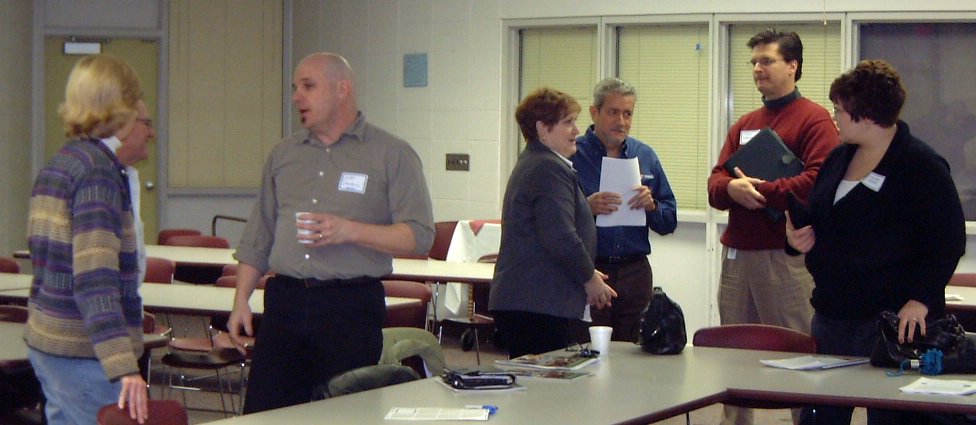
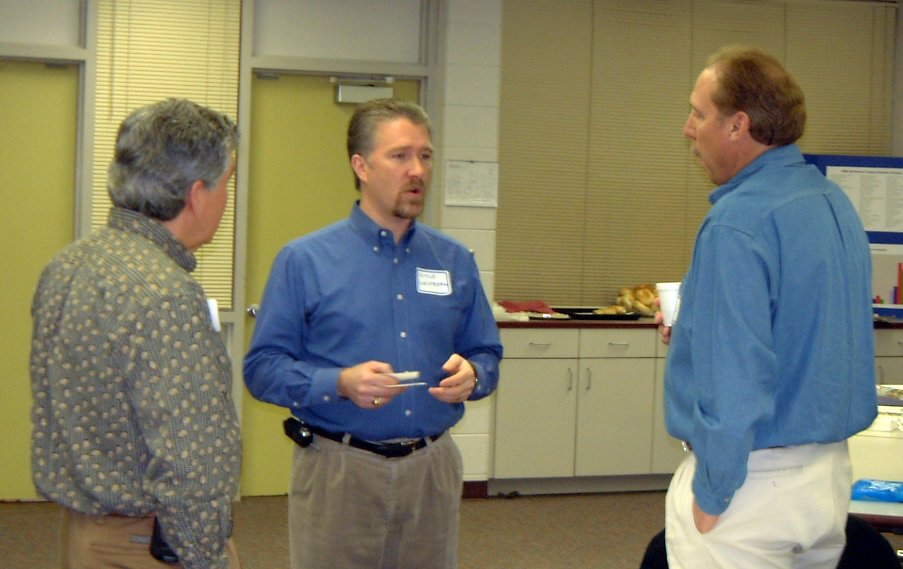

Construction Technology Cluster / Advisory Meeting 1-12-2007
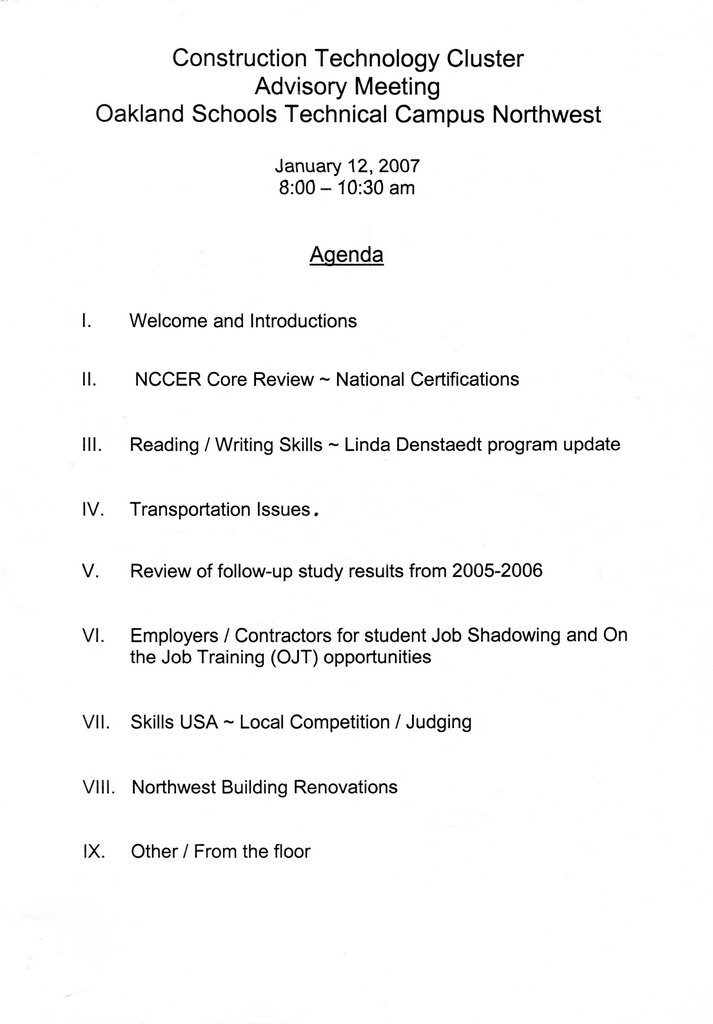
Participants
Briercheck, Paul
Denstaedt, Linda
Donnelly, Mike
Kessling, John
Lafnear, J.R.
Locklear, Chuck
Moscovic, Dick (The Delegator)
Myers, Melanie
Olds, Duane
Onslow, Mark
Plowman, Tina
Riojas, Jesse
Roberts, Jerry
Ross, Jim
Ross, Kathy
Westburg, Kyle
Weichec, Joseph
TOPICS:
NCCER Core Review / National Certification
1. 3-D AutoCAD Program (Pilot- Digital Technology in Construction)
2. Carpentry Curriculum (Rewriting)
3.
4.
5.
Reading / Writing Skills / Construction Trades Research Plan / January 2007
1. (See 5-page Documentation-Strawman, etc.)
2. Engagement (Procedural Display)
3. Active Learning
4. Transfer of Authentic Understanding
5. Research Initiative January 2007
Higher Education Initiative(s) / Oakland Community College
1. Workforce Development
2. Construction Management
3. Pilot Mentoring Program for Fall Roll-out
4.
5.
Transportation: "Mobile Training Center" (Bus)
1. Funding issues and solutions discussion.
2.
3.
4.
5.
Public Realtions, Marketing & Customer Focused Relationships
1.
2.
3.
4.
5.
Business Management Issues
1. How a real business works
2. Task Management (Scope of Work Elements)
3. "Bottom Line" financial discipline (Survival)
4. Time & Asset Management Logistics
5. Business Leaderhip (How to manage people, teams, etc.)
Alternative Energy / Green Construction
1.
2.
3.
4.
5.
*Technological Training Elements (Comments)
1. "Systems Thinking" (Begin with the end in mind)
2. Everything we do is e-mail driven
3. Technology & digital communications enhances our productivity and efficiency
4. Electronic Forms
5. Whittemore 422 Blog-site development / e-mail invitations
SUMMARY COMMENTS:
1.
2.
3.
4.
5.
6.
7.
8.
9.
10.
NEXT ADVISORY MEETING : June 15, 2007 8:00AM (Last day of School)
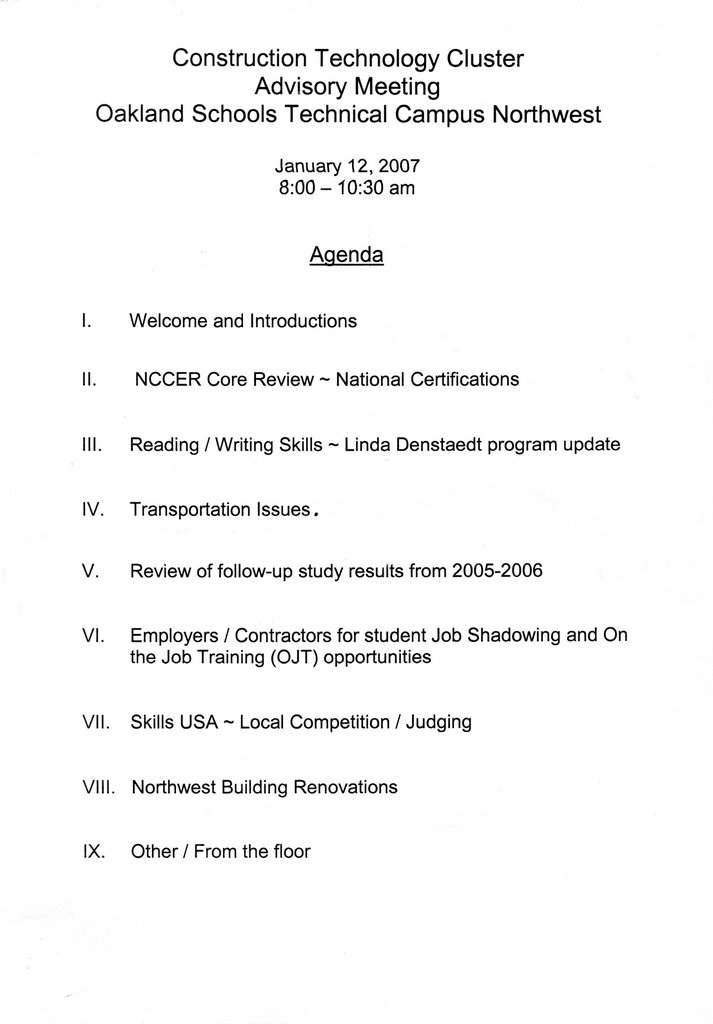
Subscribe to:
Posts (Atom)